NestLoggic Open Magpie

Magpie nests dielines three ways.

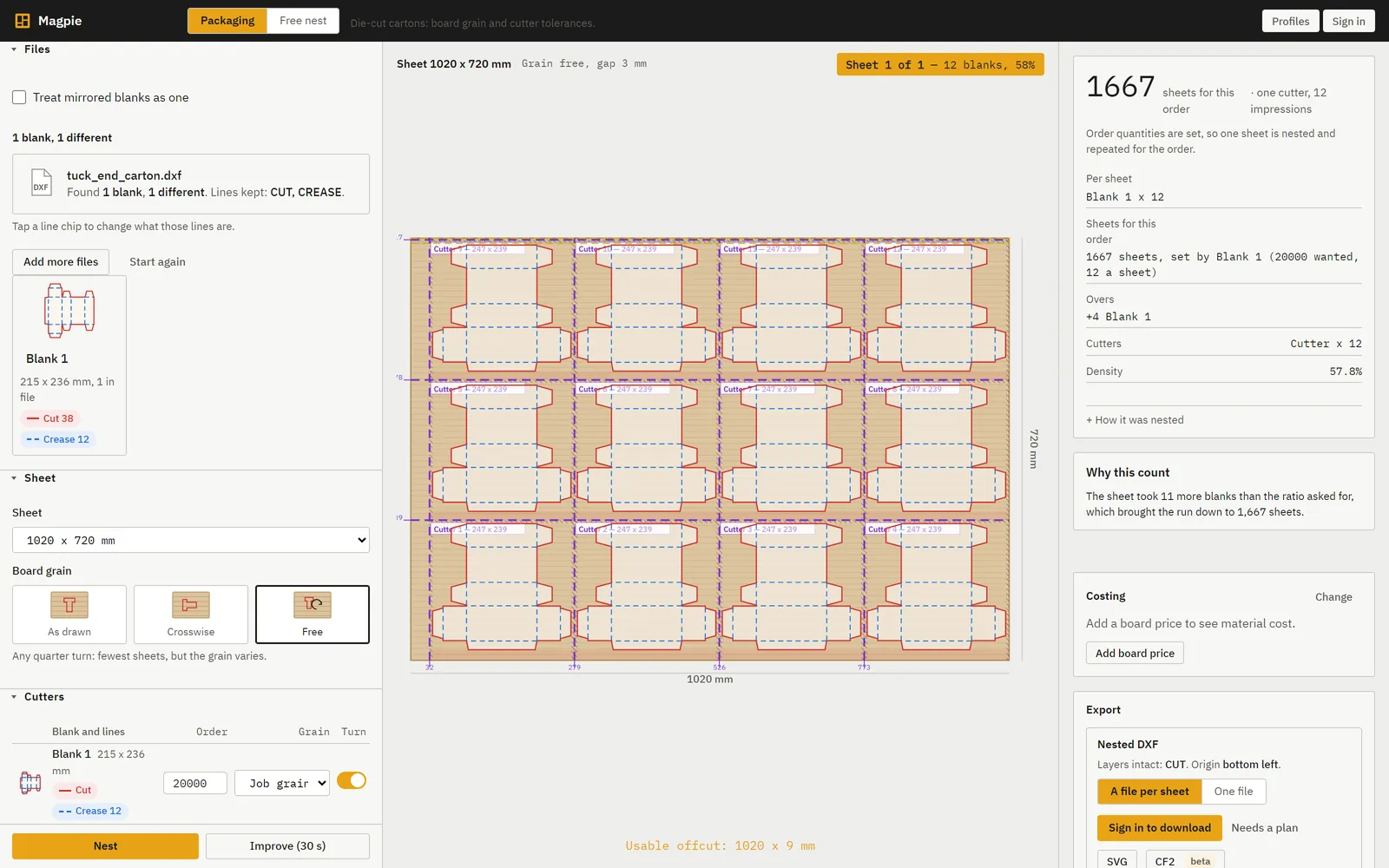
A print layout of one cutter, a full sheet under one die, or a free nest for laser and router. Each is a mode with its own rules, so the sheet comes out the way your floor would lay it, and the cutter file cuts as drawn.

Open Magpie Formats in and out Free to nest. One plan to download.

Mode 2

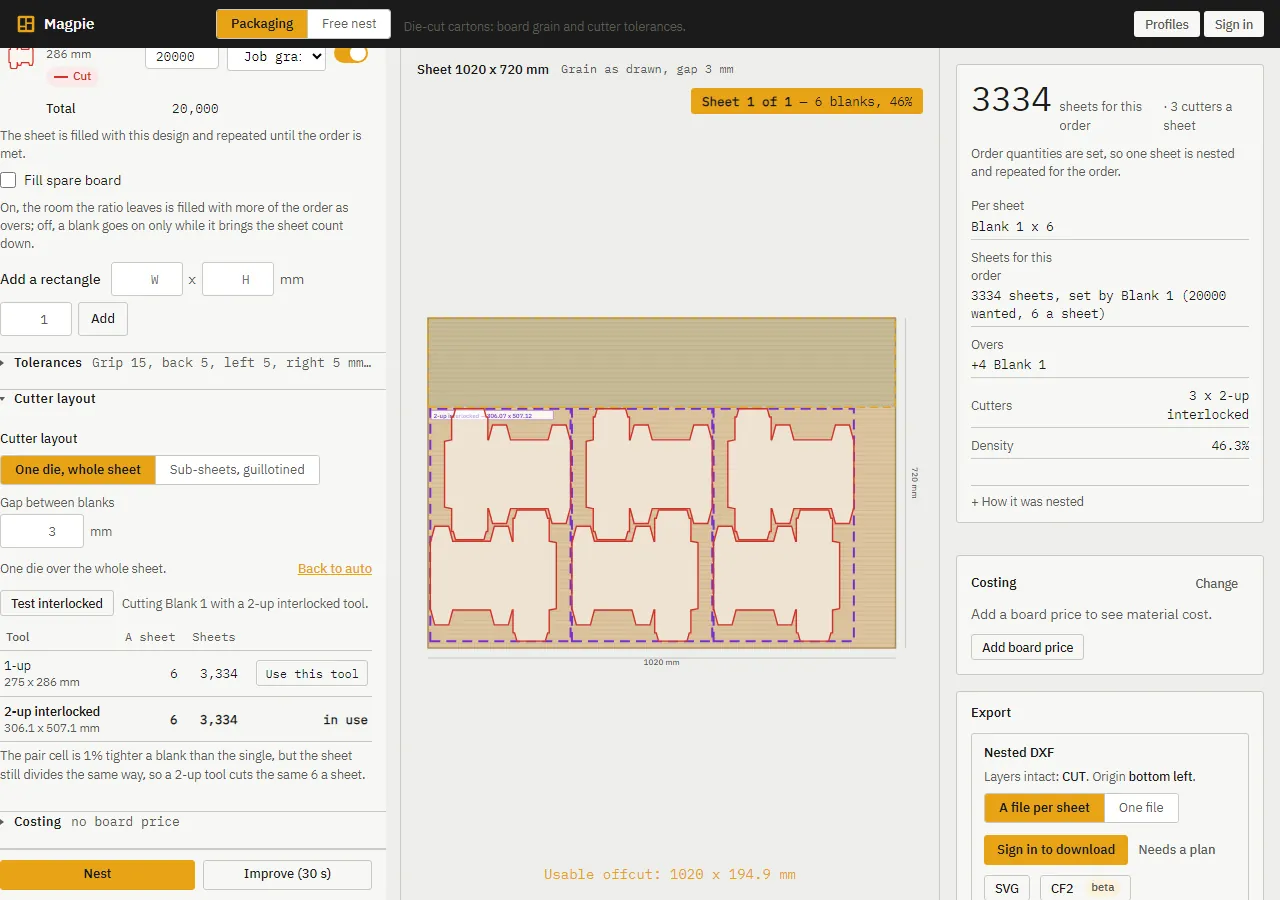
Packaging full sheet: the most on the sheet, one die

Every design in the job goes on the sheet together, as many as fit within the print bounds, and the whole sheet is cut by one die. Board grain is kept as drawn, turned crosswise, or left free; each edge keeps the larger of the print and cutter tolerances.

  • Set order quantities and Magpie nests one sheet in the order's ratio, then works out how many sheets the run takes and what is over.
  • Test an interlocked two-up tool against the single: Magpie says which cuts more a sheet and by how much.
  • Turn or lock any blank and renest around it. Improve spends thirty seconds looking for a tighter sheet.
  • Add a board price and a machine rate and the report carries the material cost, the make-ready and the run.
Magpie in packaging mode with one die over the whole sheet: six impressions of a two-up interlocked tool on a 1020 by 720 millimetre sheet, and a table comparing the single and the two-up tool by sheets for the order.
One die over the whole sheet: a two-up interlocked tool, six impressions, 3,334 sheets for the order.

Mode 3

Free nest: gap and margins, any sheet material

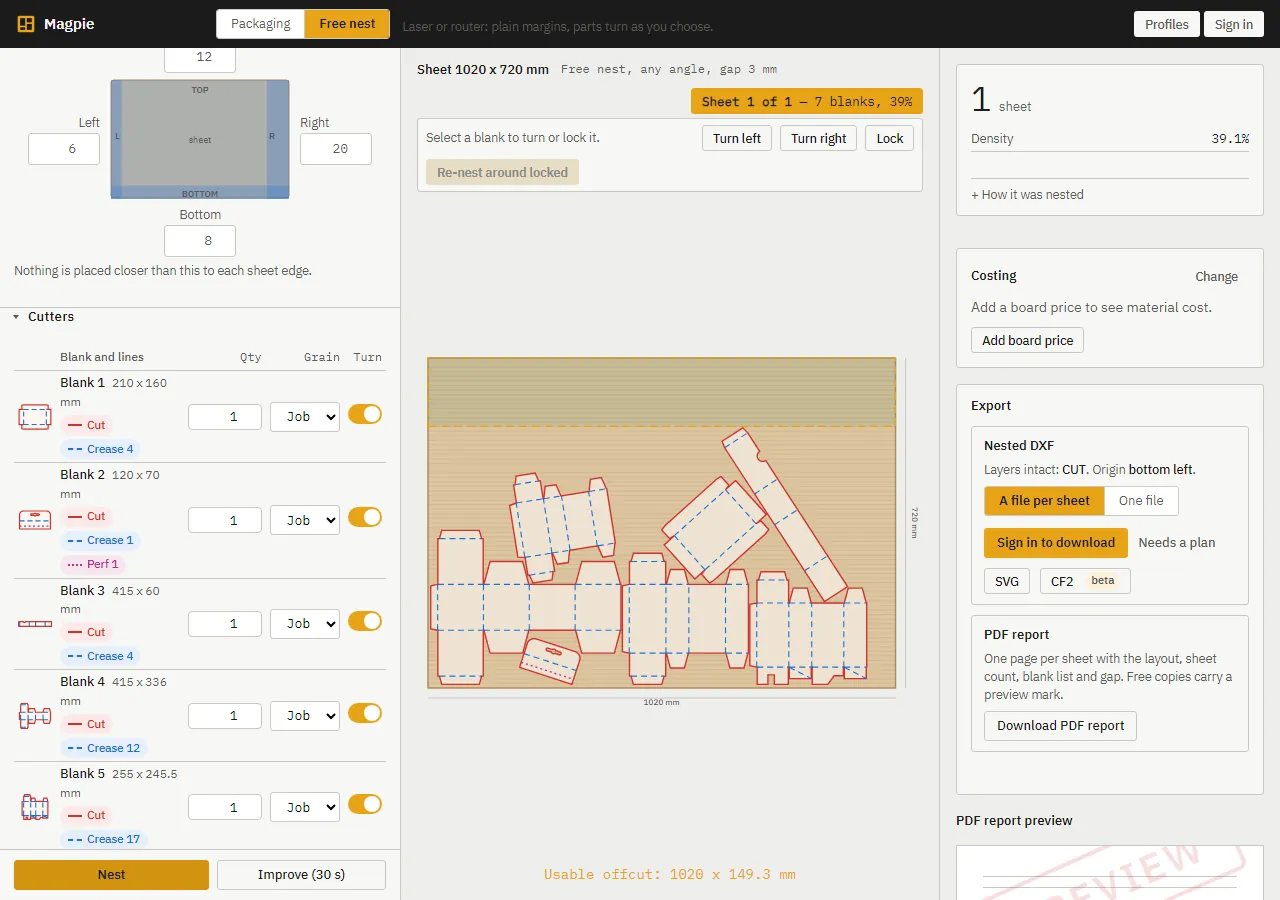
For laser, router, plotter and knife tables there is no grip and no die, so the rules are simpler: a margin on each of the four edges and a gap between parts. The gap is the kerf plus the clearance you want; the material is whatever is on the bed.

  • Parts turn as you choose: not at all, half a turn, quarter turns, or any angle in fifteen degree steps.
  • Board, corrugated, foam, plastics, MDF: the sheet is a width and a height in millimetres, up to five metres.
  • The same exports as packaging mode: layered DXF, SVG, CF2 and the PDF report, with the usable offcut measured.
Magpie in free nest mode: seven carton blanks turned at any angle on a 1020 by 720 millimetre sheet with margins on all four edges, and a strip of usable offcut along the top.
Free nest, any angle, 3 mm gap. Usable offcut 1020 by 149 mm.

Formats in and out

Files come in as drawn and go out on the layers your table expects. Nothing is flattened, renamed or redrawn on the way through.

In

  • DXF: layers, colours and linetypes read as cut, crease, perf or score; anything unclear comes back as a chip to set.
  • CF2: text or XML, with its own line types.
  • PDF: vector drawings; lettering, dimension lines and title blocks are dropped and the stroke colours proposed as classes.
  • SVG: as for PDF.

Out

  • Layered DXF: one file per sheet or one file for the job, CUT, CREASE, PERF and SCORE layers intact, GUILLOTINE layer for the cuts, origin bottom left.
  • PDF report: one page per sheet with the layout, sheet count, blank list, gap, cuts and cost.
  • SVG: the same layers, for proofing and web viewers.
  • CF2: for tables and CAD that take it (beta).

What you can rely on

Layers intact

Cut, crease, perf and score lines come back on the layers they arrived on. Nothing is flattened into one layer for you to sort out at the table.

Gap held

The gap you set is the smallest distance between any two blanks on every sheet. Magpie measures it after nesting and prints the figure.

Nicks preserved

Nicks and bridges in your dieline stay exactly where you drew them, on every copy of the blank, at every rotation.

Cuts dimensioned

Every guillotine cut is labelled with its distance from the grip edge or the left edge, on the board, in the DXF and in the report.

Nest a job now. Sign in only when you download.

Open Magpie